
3DP2-ModCon: Toward 3D printing modular construction using recycled plastics
Principal researcher:
José Luis Bonet Senach
Pedro Francisco Miguel Sosa
Team members:
- Miguel Ángel Fernández Prada
- Xavier Mas Barberà
- Miguel Sánchez López
- José Ramón Albiol Ibáñez
- Jorge Sanchis Guerola
- Alberto García Cárcel
- Lino José Martínez Todolí
Funding Agency:

Duration: 01/12/2022 – 30/09/2025
Reference: TED2021-129358B-I00
Abstract
A more sustainable and competitive construction must necessarily respond to the challenge of climate change by focusing on reducing waste and greenhouse gas (GHG) emissions. The construction sector is responsible for 35% of waste in the European Union and between 5 and 12% of total GHG emissions worldwide. Additive manufacturing can help reduce this waste and GHG emissions to address this challenge. The synergies and opportunities of AM in the construction industry can contribute to the digital transition of its value chain.
AM in structural construction has the following advantages: building customized designs, improving accuracy and final appearance, reducing resource consumption, contributing to the reduction of GHG emission, reducing energy consumption and waste, and automating manufacturing processes.
The European Additive Manufacturing Technology Platform points out that the strategic action with the most significant environmental and social impact is the role to be played by AM in the circular economy of material resources. There is a need to recycle objects manufactured with this technology and recycled materials to produce components and products.
On the other hand, pollution from plastic waste poses a significant threat to the environment. The valorization (technical, economic, and legislative) of plastic waste aims to integrate the circular economy into the plastic value chain and provide a solution to the accumulation of plastic waste. 3D printing with plastic can play a relevant role in transitioning to a circular economy.
Currently, this technology is developing and spreading, although realizations of 3D printed bridges made of plastic, virgin or recycled, are scarce. The small number of tests carried out to date on plastic structures limits the use of this material in the construction industry and the development of design codes or technical specifications.
Modular construction using segmented elements of structures is a solution to the technical limitation of 3D printing, avoiding the need for large 3D printers, and administrative, preventing the need for special transport authorizations. However, the design and execution of the connection between segmented elements are critically important due to the necessity to provide continuity to the forces.
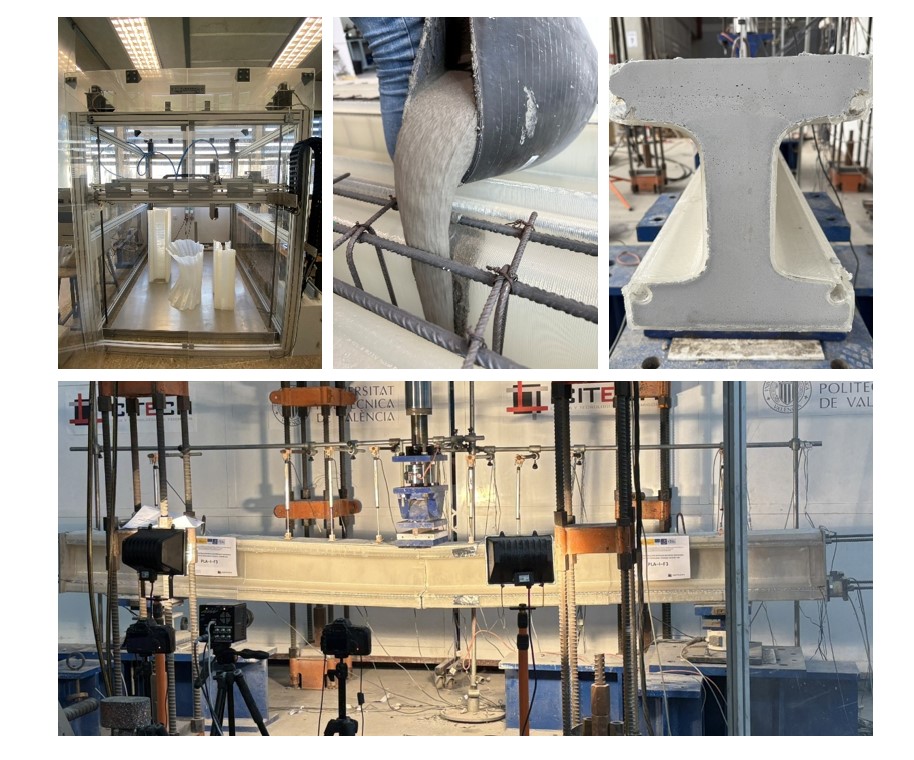
This project aims to develop technology for constructing mechanically efficient and durable hybrid structures formed by the assembly of 3D printed longitudinal hollow segments made of recycled plastic filled with cocrete. The development of modular construction using 3D printing with recycled plastics is an alternative technology that will help the construction industry move towards a green and digital transition and become more competitive by applying innovative, more sustainable solutions with lower life-cycle costs.