Enclose: Exploring the use of timber-concrete composite (TCC) structures to prevent the progressive collapse of buildings
Principal researcher:
Jose M. Adam
Manuel Buitrago
Team members:
- Juan J. Moragues
- Pedro A. Calderón
- Benoit Gilbert
- Christian Malaga-Chuquitaype
- Nirvan Makoond
- Juan C. Reyes-Suárez
- Juan S. Aristizábal
Funding Agency:

Duration: 01/09/2025 – 31/08/2028
Reference: PID2024-160639OB-I00
Abstract
Buildings are increasingly exposed to extreme events that can trigger initial failures propagating to the rest of the structure. Such propagation often results in a final collapse that is disproportionate compared to the extent of the initial failure. This phenomenon, known as progressive collapse, can be avoided by implementing recommendations outlined in current guidelines to improve structural robustness.
This involves measures to increase the continuity, redundancy and ductility of building structures, either by introducing tying elements or by applying the Alternative Load Path (ALP) method. By improving the connectivity between structural elements, the load of any failed element can be redistributed to neighbouring elements of the structural system. This enhances the resistance mechanisms of a building, including the flexural mechanism during the first stages of collapse and the catenary action as the last line of defence.
In the latter case, a structure must be able to accommodate large deformations and rotations at connections, so that structural elements near failure can work efficiently in tension. Although this mechanism has proven to work efficiently for concrete or steel structures, it has significant limitations for timber structures.
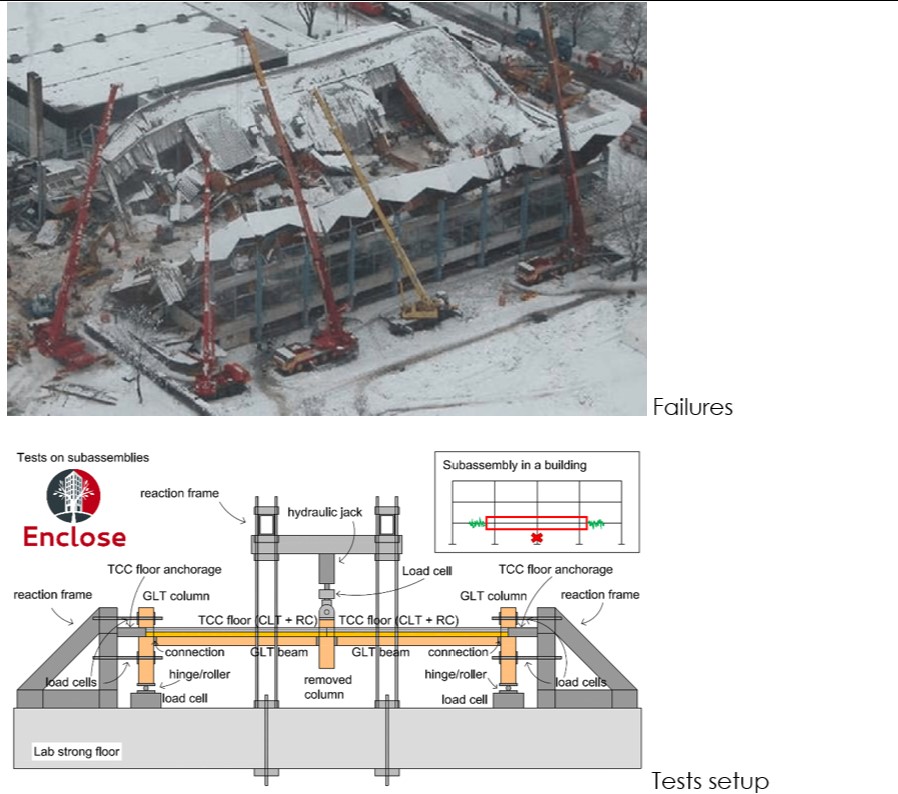
The overall aim of Enclose is to develop timber-concrete composite (TCC) solutions to fulfil current robustness requirements and prevent the progressive collapse of buildings. Enclose introduces, for the first time, the use of TCC in the field of structural robustness of timber structures. The project will contribute to knowledge generation and will go significantly beyond the state of the art. It will open a new line of research in which TCC is used to enhance robustness and will develop new solutions for an environmentally friendly sector to improve the safety and service performance of timber buildings.