3DCP-SEGBEAM: Exploring 3D concrete printing segmented beams to foster sustainability in construction
Principal researcher:
José Luis Bonet Senach
Pedro Francisco Miguel Sosa
Team members:
- Miguel Ángel Fernández Prada
- José Ramón Albiol Ibáñez
- Miguel Sánchez López
- Lisbel Rueda García
- Rogelio Franco Segarra
- Alberto García Cárcel
- Lino José Martínez Todol
Funding Agency:

Duration: 01/09/2022 – 31/08/2026
Reference: PID2021-126397OB-I00
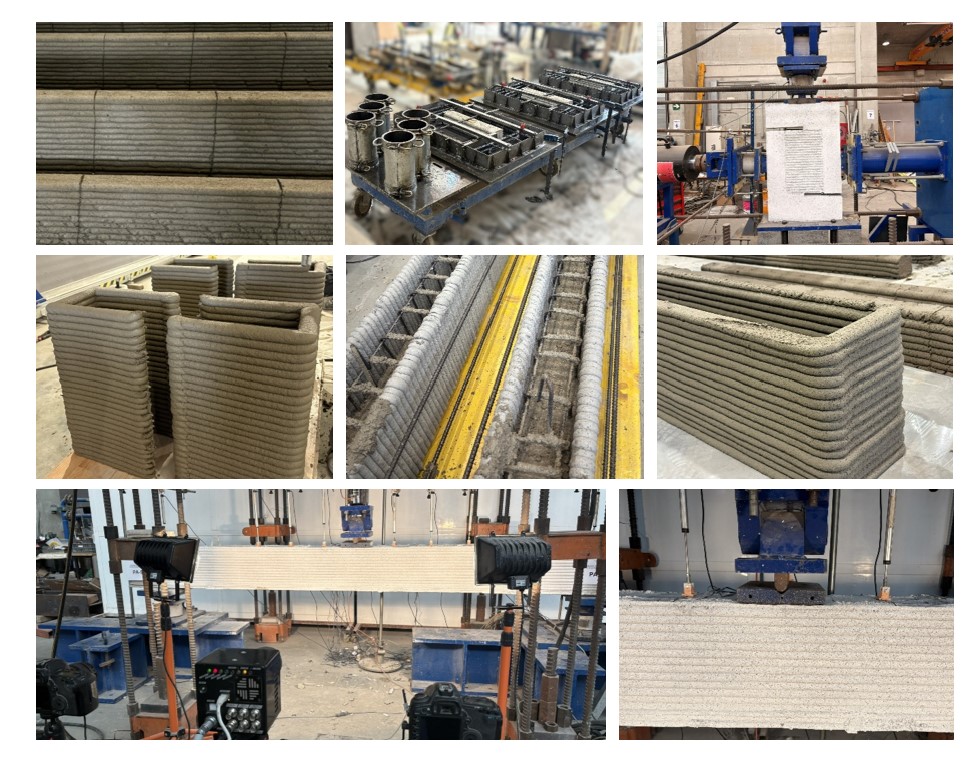
Abstract
More sustainable and competitive construction must necessarily address to the challenge of climate change by focusing on reducing waste and greenhouse gas (GHG) emissions. Construction is responsible for about 35% of waste in the European Union and 5-12% of total global GHG emissions. To address this challenge, additive manufacturing can help reduce this waste and GHG emissions. The European Additive Manufacturing Technology Platform (AM Platform), indicated in 2018, that construction is key to the development of this technology.
Additive manufacturing in construction of concrete structures, 3D concrete printing (3DCP), has the following advantages: building customised designs, improving precision and final appearance, reducing the use of resources during the manufacturing process and of the product itself, contributing to the reduction of greenhouse gas emissions, reducing energy consumption and waste, using new materials to improve durability, serviceability and resilience, and automating manufacturing processes, which means a reduction in lead times, manpower and risk of occupational accidents.
AM-Platform has defined as one of its strategic actions with a major economic-industrial and environmental-social impact, the development of strategies for integrating reinforcement into concrete structures manufactured with 3DCP. The underdevelopment of these strategies limits the expansion of 3D concrete printing structures on a large scale. This difficulty is a technological barrier to the growth of 3D printing in construction.
On the other hand, the maximum length of 3D printed concrete beams is limited by the specific printing technique and by road transport (weight and length). Construction using segmented beams can be a solution to this technical and administrative difficulty, avoiding special permissions and reducing delivery times. The design and execution of the connection between segmented concrete elements manufactured with 3D printing is of critical importance, as it is essential to provide continuity of forces. The type of connection depends on the specific printing technique.
The small number of existing experimental tests of both 3D printed beams and the connections of printed elements limits the verification of their resistance capacity and, if necessary, the adaptation of the Structural Codes for printed elements, as well as their technological development.
The aim of this project is to contribute to the development of strategies for manufacturing segmented concrete beams with 3D printing by extrusion, for promoting their use and favouring more sustainable construction. This project explores different solutions that consider the use of different materials and hybrid technologies (digital and conventional construction). In addition, different strategies are analysed for integrating reinforcement in printed beams and designing the connection between segmented beams, with safety, serviceability, and resilience criteria.