3DP-Formwork: 3D printed formwork to foster sustainable construction of concrete structures
Principal researcher:
José Luis Bonet Senach
Pedro Francisco Miguel Sosa
Team members:
- Miguel Ángel Fernández Prada
- José Ramón Albiol Ibáñez
- Lisbel Rueda García
- Alberto García Cárcel
- José Guillermo Muñoz Montes
- Lino J. Martínez Todolí
Funding Agency:

Duration: 01/09/2025 – 31/08/2028
Reference: PID2024-156847OB-I00
Abstract
Concrete is the most widely used material in the world and one of the most sustainable in construction. However, it accounts for about 8% of greenhouse gas emissions worldwide. The adoption of efficient methods in construction is one of the leading research objectives in civil engineering, architecture and materials science. 3D printing has emerged as an alternative to conventional construction that could help reduce the resource consumption of processes and products, streamline manufacturing processes and make products more sustainable.
Formwork manufacturing accounts for a large part of the total costs of constructing a concrete element, especially when its shape is not standard. Although concrete can theoretically be cast in any shape, standard orthogonal structures are the most common in practice. These structures use formwork based on modular, standardised and reusable panels, which are easier to manufacture, transport, install and reuse. Using these formworks results in oversized designs, producing the paradox of using more materials to reduce costs.
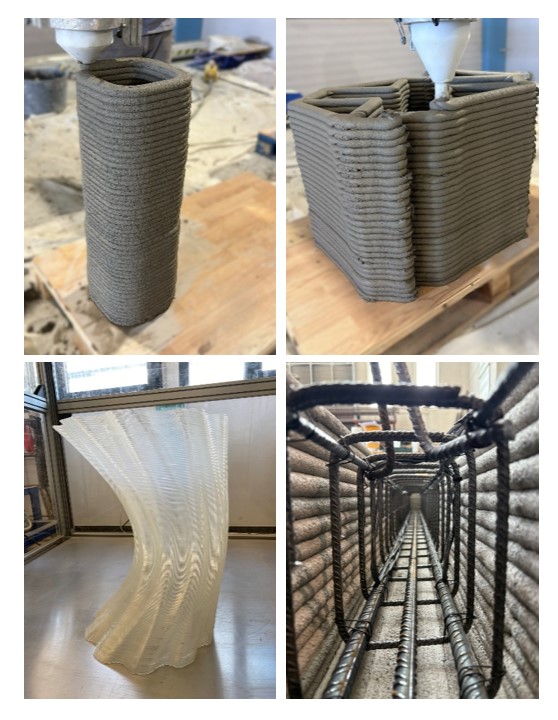
3D printing of formwork (3DPF) allows freedom of form for concrete structures. The use of this technology makes it possible to improve precision and final appearance, reduce the consumption of resources, contribute to the reduction of greenhouse gas emissions, reduce energy consumption and waste, and automate manufacturing processes. Today, the potential of using 3DPF in concrete structures has been demonstrated. However, no standards or guidelines exist for applying 3D printing technology to concrete structures.
Using 3DPF by polymer extrusion in concrete structures allows freedom of shape of the element, as well as an improvement in precision and final appearance. However, the limited number of tests available, in addition to the small size of the specimens tested, limits the assessment of the functional and/or structural capacity of these 3DPFs.
The use of 3DPF by concrete extrusion has been demonstrated, especially in columns and post-tensioned segmental beams. Currently, the number of tests is limited and focused on the simple compression behaviour of columns and the flexural behaviour of post-tensioned segmental beams. This experimental gap limits the validation of this technology and the development of methods, recommendations and guidelines for use in 3D printing.
The project’s overall objective is to study the behaviour of concrete structures with permanent 3D printed formworks to assess their structural and/or functional contribution, promote their use, and move towards a more sustainable construction industry. This project explores different 3DPF solutions for beams and columns by polymer extrusion and concrete extrusion. This study aims to contribute to the development of calculation methods, recommendations and guidelines for use, and a future regulatory framework.