Enclose: Exploring the use of timber-concrete composite (TCC) structures to prevent the progressive collapse of buildings
Host professor (supervisor):
José Miguel Adam Martínez
Scientific collaborators:
- Fabio Freddi; Carmine Galasso (University College London)
- Thomas Gernay (Johns Hopkins University)
- Eyitayo Opabola (UC Berkeley)
Funding Agency:

Duration: 15/10/2025 – 14/10/2028
Reference: LCF/BQ/PR25/12110011
Abstract
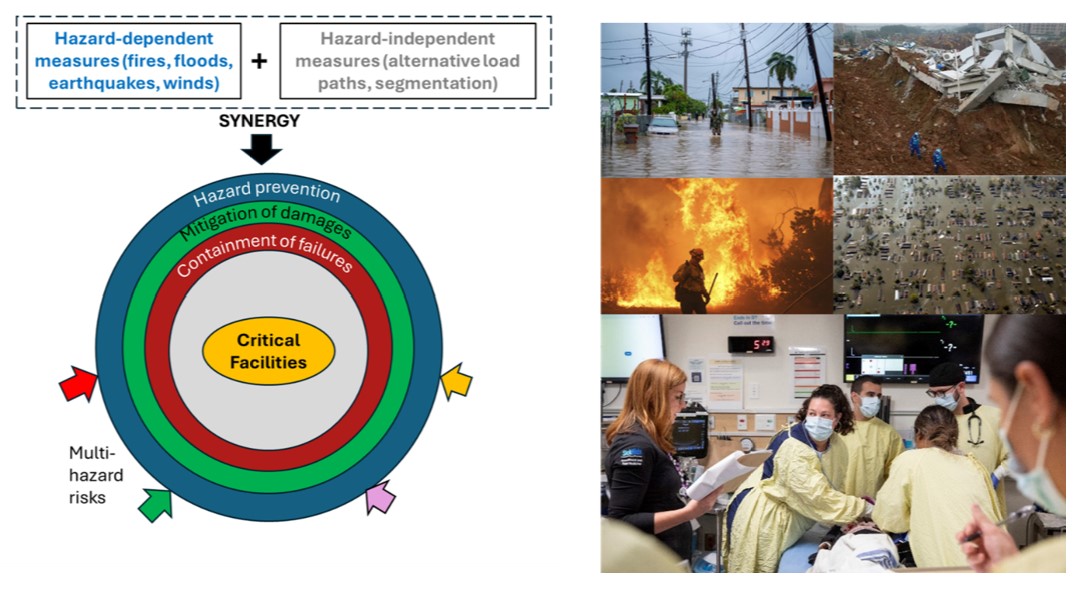
Driven by climate change and escalating global conflicts, the built environment faces increasingly severe and unpredictable extreme events. For critical infrastructure, such as hospitals, fire stations, shelters, and emergency centers, resilience is crucial for maintaining life-saving services and minimising post-disaster costs. However, current design guidelines for designing critical facilities remain fragmented, treating hazards in isolation and neglecting conflicting interactions between specific safety measures. Protective measures that are effective for a certain hazard may lead to worse behavior in other hazards, resulting in less resilient infrastructure. Furthermore, they often overlook “black swan” events—unforeseen threats with devastating consequences.
The proposed project, Enring, addresses these gaps by developing a multi-layered defense framework to enhance the structural resilience of critical buildings. The method is inspired by the principle of Defense-in-Depth (DD) that organizes protective measures into successive lines of defense: outer layers mitigate predictable, high-probability hazards, while inner layers act as the final safeguard against unforeseen, catastrophic events.
The core objective evolves from prevention to mitigation and, ultimately, to damage control or containment, as the severity of the scenario escalates. By integrating harmonized multi-hazard strategies, Enring aims to achieve an optimal synergy that moves beyond traditional, single-threat (fragmented) design frameworks. The project’s success will strengthen societal resilience and enhance our collective preparedness for future threats.